 rganauta
Cardiomyocyte in 3D
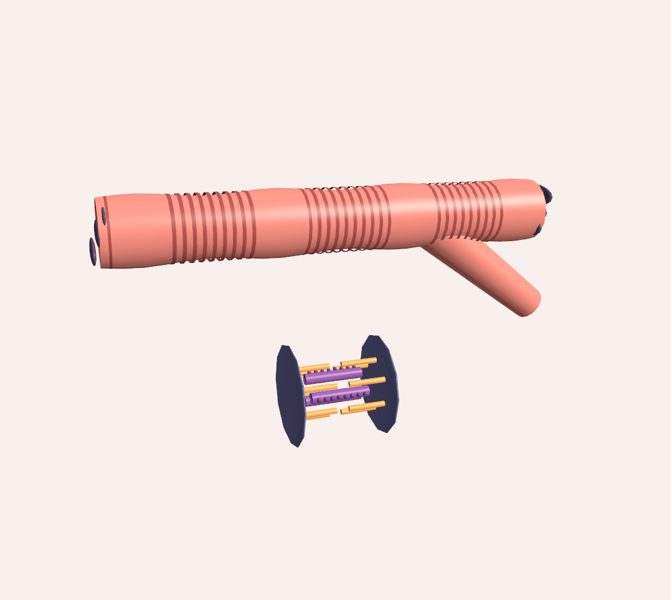
A striated, branched muscle cell about 100 µm long, with a central nucleus (sometimes two) and loads of mitochondria because it never rests. It joins its…
Explained for every age
For kids (7–11)
The muscle cell of the heart. It's like a striped brick that squeezes and stretches nonstop, your whole life, without you having to think about it. Watch how it gets shorter with every heartbeat.
For teens (12–16)
A striated, branched muscle cell about 100 µm long, with a central nucleus (sometimes two) and loads of mitochondria because it never rests. It joins its neighbors through intercalated discs that let the electrical signal pass: that's how the whole heart contracts at once. The stripes are sarcomeres, the unit that shortens.
Pre-Med (17+)
Cardiac myocyte: ≈ 100 × 15 µm, branched, one or two central nuclei, very abundant mitochondria, T tubules at the Z lines, sarcoplasmic reticulum with Ca²⁺-induced Ca²⁺ release (ryanodine receptor). Intercalated discs with desmosomes, fascia adherens and gap junctions (connexin 43): a functional syncytium. Action potential with a Ca²⁺ plateau (phase 2) and a long refractory period that prevents tetany. Very slow turnover (less than half of cardiomyocytes are replaced over a lifetime): an infarction leaves a fibrous scar.
What you can explore
Cardiomyocyte nucleusCardiomyocyte mitochondriaIntercalated discSarcomere and Z discsThin filament (actin)Thick filament (myosin)
Missions
- The brick that beats Explorer
- Sliding filaments Discoverer
- Sarcomere and cardiac clinical practice Pre-Med