 rganauta
Cell energy in 3D
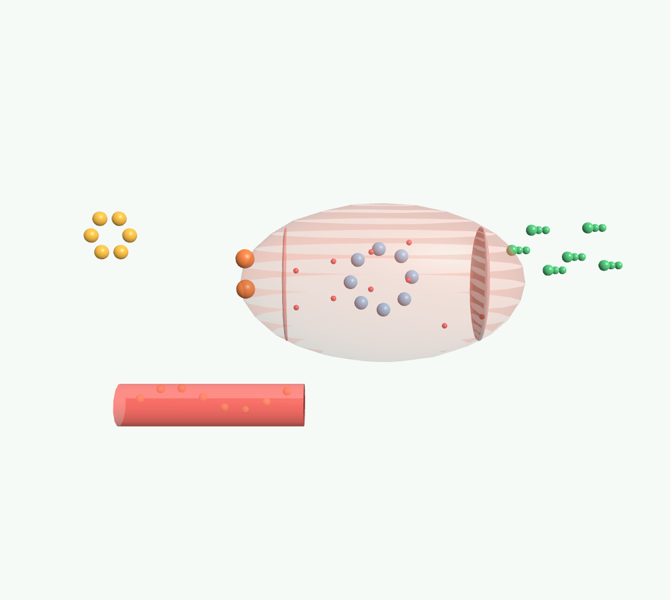
Your cells get energy from food through cellular respiration. Glucose is first broken down in the cytoplasm (glycolysis) and then, inside the…
Explained for every age
For kids (7–11)
Each of your cells is like a tiny factory that needs energy to work. Using sugar from food and the oxygen you breathe, it makes teeny "batteries" called ATP. What's left over is carbon dioxide, which leaves your body when you breathe out, and a little bit of water.
For teens (12–16)
Your cells get energy from food through cellular respiration. Glucose is first broken down in the cytoplasm (glycolysis) and then, inside the mitochondria, in the Krebs cycle and the electron transport chain, which uses oxygen. The result is ATP, the molecule that pays for almost all of the cell's work, plus carbon dioxide and water. When oxygen runs short, some cells switch to fermentation, which makes much less ATP.
Pre-Med (17+)
Aerobic cellular respiration oxidizes glucose according to the overall equation C6H12O6 + 6 O2 → 6 CO2 + 6 H2O, coupling the energy released to ATP synthesis. Stages: glycolysis (cytosol; 2 net ATP and 2 NADH per glucose), oxidative decarboxylation of pyruvate to acetyl-CoA and the citric acid cycle (mitochondrial matrix; they release CO2 and reduce NAD+ and FAD), and oxidative phosphorylation (inner mitochondrial membrane), where the electron transport chain builds a proton gradient that drives ATP synthase. The estimated yield is around 30 ATP per glucose (between 29 and 32 depending on the source and cell type). Without oxygen, lactic acid fermentation regenerates NAD+ to keep glycolysis going.
What you can explore
GlycolysisCitric acid cycle (Krebs cycle)Electron transport chainATP (adenosine triphosphate)Lactic acid fermentation
Missions
- Your cells' batteries Explorer
- The glucose route Discoverer
- Cellular bioenergetics Pre-Med