 rganauta
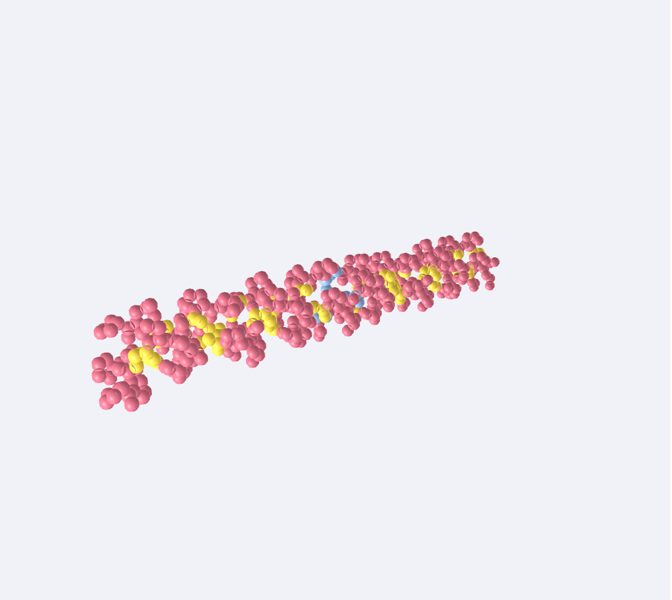
Collagen (real molecule) in 3D
Collagen is the most abundant protein in mammals: between 25% and 35% of all their proteins. Each molecule has three coiled chains that form a triple…
Explained for every age
For kids (7–11)
Collagen is the most abundant protein in mammals, like you. It's in bones, skin, tendons and cartilage, and it makes them tough. It's three strands twisted together, like a braided rope. What you see is a small model piece that copies that braid, atom by atom.
For teens (12–16)
Collagen is the most abundant protein in mammals: between 25% and 35% of all their proteins. Each molecule has three coiled chains that form a triple helix, and many molecules line up into very strong fibrils and fibers that support bones, skin, tendons and ligaments. What you see is not a complete collagen but a model: a short peptide with the repeating sequence proline–hydroxyproline–glycine that forms the same triple helix (PDB 1CAG).
Pre-Med (17+)
Tropocollagen: about 300 nm long and 1.5 nm in diameter; three α chains, each in a left-handed helix (not an α-helix), wound into a right-handed superhelix stabilized by hydrogen bonds. Gly-X-Y repeat, with frequent Gly-Pro-X and Gly-X-Hyp motifs: glycine occupies every third position because it lies on the axis of the triple helix. By 2011, 28 types had been described in humans; more than 90% is type I and III, and type I is the main organic component of bone. 1CAG is not natural collagen: it is the model peptide (Pro-Hyp-Gly)₄-Pro-Hyp-Ala-(Pro-Hyp-Gly)₅, three chains of 30 residues, at 1.85 Å (Bella, Eaton, Brodsky and Berman, 1994).
What you can explore
GlycineProline and hydroxyprolineOther amino acids (alanine)
Missions
- The three-strand rope Explorer
- Why every third one is glycine Discoverer
- The triple helix and its failures Pre-Med