 rganauta
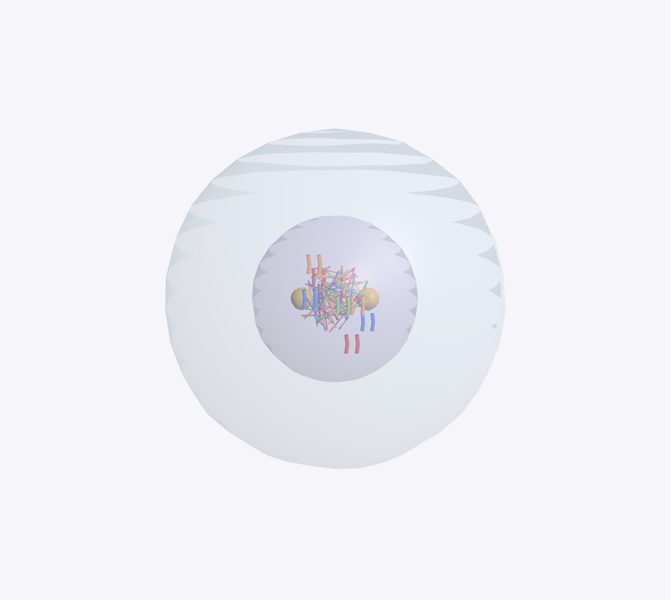
Cell division (mitosis) in 3D
In mitosis, a cell that has already duplicated its chromosomes separates them into two identical nuclei; then cytokinesis splits the cell in two. The…
Explained for every age
For kids (7–11)
Mitosis is how one cell divides into two twin cells. First it copies all its instructions, the chromosomes, and then it gives an exact copy to each new cell. That's how you grow and how your skin renews itself.
For teens (12–16)
In mitosis, a cell that has already duplicated its chromosomes separates them into two identical nuclei; then cytokinesis splits the cell in two. The phases are prophase, prometaphase, metaphase, anaphase, and telophase. The scene shows only 4 pairs of chromosomes so they are easy to see; your cells have 23 pairs, that is, 46 chromosomes. The fruit fly, on the other hand, really does have 4 pairs.
Pre-Med (17+)
Part of the eukaryotic cell cycle in which replicated chromosomes are separated into two genetically identical nuclei; it is an equational division that preserves chromosome number. It is preceded by the S phase of interphase (G1, S, G2), in which DNA is replicated, and is usually followed by cytokinesis; together they form the M phase. In prometaphase the nuclear envelope breaks down (open mitosis, typical of animals) and spindle microtubules attach to the kinetochores; in metaphase the chromosomes line up on the metaphase plate and, after the checkpoint, sister chromatids separate in anaphase. Checkpoints and cyclin-CDK complexes regulate progression from one phase to the next. The scene is a 24 s diagram with 4 pairs of homologs (8 chromosomes), not the 23 human pairs.
What you can explore
ChromosomeMitotic spindleCentrosomeNuclear envelopeCytokinesisDaughter cellsMeiosis
Missions
- One cell, two twins Explorer
- The phases of mitosis Discoverer
- Spindle, kinetochores, and checkpoints Pre-Med