 rganauta
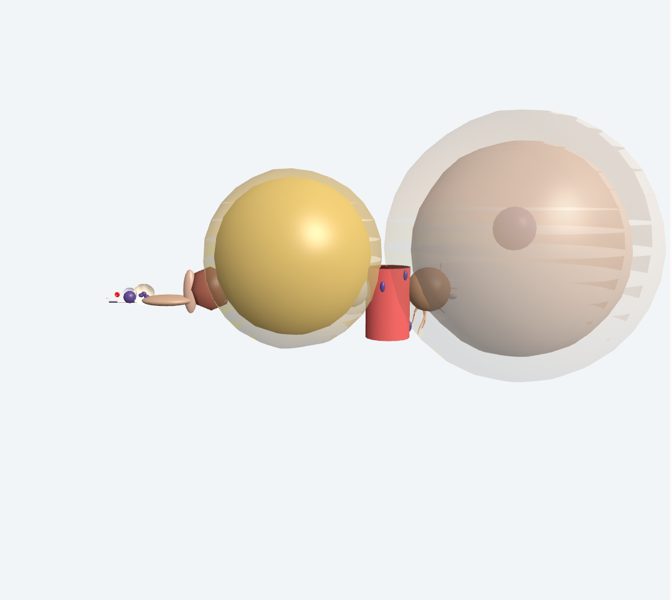
Body cells (to scale) in 3D
About 30 to 40 trillion cells of more than 200 types, all with the same DNA but reading different pages. Compared to scale: the platelet (2 µm), the red…
Explained for every age
For kids (7–11)
Your body has more than 200 types of cells, and here you see the most important ones lined up, at their real sizes compared to each other: from the tiny platelet to the egg cell, which you can almost see with the naked eye. Each section of the gray and white ruler measures 10 microns: a hair is 70.
For teens (12–16)
About 30 to 40 trillion cells of more than 200 types, all with the same DNA but reading different pages. Compared to scale: the platelet (2 µm), the red blood cell (7.5 µm), white blood cells (8–12 µm), epithelial cells (10–30 µm), the hepatocyte (25 µm), the adipocyte (100 µm) and the oocyte (120 µm), one of the largest cells. The neuron has a 25 µm cell body but its axon can be a meter long; the muscle fiber is a single cell several centimeters long.
Pre-Med (17+)
Tissue classification: epithelial (covering and glandular; polarity, junctions), connective (fibroblasts, adipocytes, chondrocytes, osteocytes, blood cells), muscle (skeletal, cardiac, smooth) and nervous (neurons, glia). Sizes and shapes as functional correlates: surface/volume, nucleus/cytoplasm, specializations (microvilli, cilia, flagellum). Cycle and renewal: from hours or a few days (circulating neutrophil) to a whole lifetime (neurons, cardiomyocytes, oocytes).
What you can explore
PlateletKeratinocyteEnterocyteHepatocyteOsteocyteChondrocyteSpermatozoonOocyte10 µm scale ruler
Missions
- From the smallest to the biggest Explorer
- Form follows function Discoverer
- Cytology and clinical practice Pre-Med