 rganauta
Genetics and heredity in 3D
Genetics studies how traits are inherited. The information is in DNA, organized into genes. Each person has two copies of almost all their genes, one…
Explained for every age
For kids (7–11)
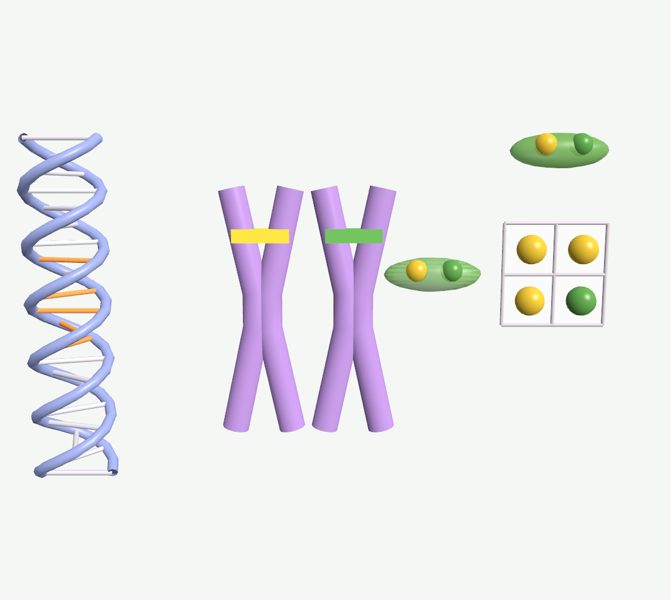
You look a bit like your family because you got half of your genes from each of the two people who gave you life. Genes are like recipes written in DNA, the spiral staircase on the left. In the center are two chromosomes, one from each of those two people, with the same recipe marked. On the right, some peas show how colors are passed from plants to their offspring.
For teens (12–16)
Genetics studies how traits are inherited. The information is in DNA, organized into genes. Each person has two copies of almost all their genes, one inherited from each biological parent, and those copies can be different versions (alleles). The scene goes from small to large: a gene in the double helix, the same gene on a pair of homologous chromosomes and, on the right, the Yy × Yy pea cross that Gregor Mendel studied, with its Punnett square.
Pre-Med (17+)
The human genome contains about 19,900 protein-coding genes, distributed across 23 pairs of chromosomes. Each autosomal locus is present in two copies, one maternal and one paternal, which can be identical alleles (homozygosity) or different ones (heterozygosity). The relationship between genotype and phenotype ranges from monogenic traits with classic Mendelian inheritance to polygenic and multifactorial traits, involving many loci and the environment. The scene brings together three levels: sequence (gene), chromosome (homologous alleles) and a population of offspring (Mendelian ratios).
What you can explore
GeneAlleleDominant and recessivePunnett squareMendel's peasMutation
Missions
- Why do I look like my family? Explorer
- Mendel's crosses Discoverer
- Inheritance patterns Pre-Med