 rganauta
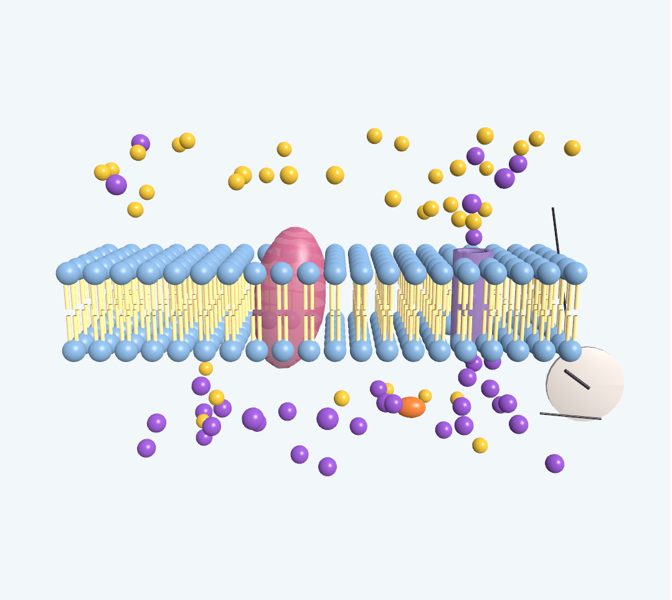
Sodium–potassium pump in 3D
The sodium–potassium pump is a protein in the membrane of all animal cells. It uses the energy of one ATP molecule to push 3 sodium ions (Na⁺) out and…
Explained for every age
For kids (7–11)
In the skin of every cell there are some very special doors. Every time they move, they push 3 little grains of sodium out and bring 2 of potassium in, and to do that they use up a tiny bit of energy. Thanks to them, your nerves and your muscles can work.
For teens (12–16)
The sodium–potassium pump is a protein in the membrane of all animal cells. It uses the energy of one ATP molecule to push 3 sodium ions (Na⁺) out and bring 2 potassium ions (K⁺) in, both against their concentration gradient: this is active transport. This way the cell keeps a lot of sodium outside and a lot of potassium inside, which is essential for nerve signals, muscle contraction and controlling the cell's volume. It was discovered by the Danish scientist Jens Christian Skou in 1957.
Pre-Med (17+)
The Na⁺/K⁺-ATPase is an electrogenic P-type ATPase present in the plasma membrane of all animal cells. For each ATP hydrolyzed it extrudes 3 Na⁺ and takes in 2 K⁺, with a net outward movement of one positive charge per cycle. It maintains the gradients of Na⁺ (high in the extracellular fluid) and K⁺ (high in the cytosol), which sustain the resting potential, the excitability of neurons and muscle, secondary active transport (for example, sodium–glucose cotransport in the intestine and renal tubule) and cell volume regulation. Skou proposed it in 1957 and for this received half of the 1997 Nobel Prize in Chemistry.
What you can explore
Phospholipid bilayerNa⁺/K⁺-ATPaseSodium ions (Na⁺)Potassium ions (K⁺)ATP (pump energy)Resting membrane potential
Missions
- The door that never rests Explorer
- Uphill with ATP Discoverer
- The Post-Albers cycle Pre-Med
- Case: neurons out of energy Pre-Med