 rganauta
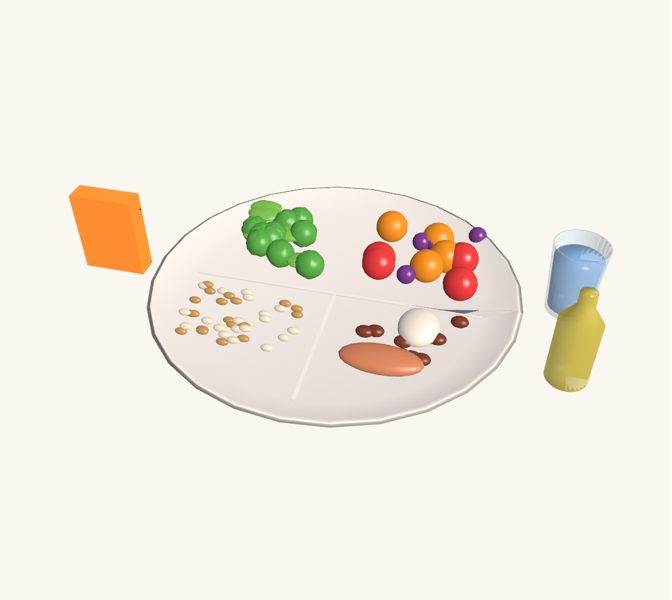
Healthy plate in 3D
Nutrients are grouped into two big families. Macronutrients, which you need in larger amounts, are carbohydrates, proteins and fats: they provide energy…
Explained for every age
For kids (7–11)
Food gives your body two things: energy to play, think and grow, and "pieces" to build and repair your muscles, bones and skin. No single food has everything you need, so it's good to eat a variety: vegetables, fruit, grains, beans and lentils, eggs, dairy or fish, and water to drink. Eating is also about enjoying, sharing with your family and trying new flavors. Nobody is better or worse because of what they eat.
For teens (12–16)
Nutrients are grouped into two big families. Macronutrients, which you need in larger amounts, are carbohydrates, proteins and fats: they provide energy and building materials for the body. Micronutrients, vitamins and minerals, are needed in very small amounts but are essential. Water gives no energy, but it is essential for life. Reading the label on a package helps you know what's in it: the ingredient list goes from the largest to the smallest amount, and in Chile and other countries black "ALTO EN" ("HIGH IN") seals warn when a product has a lot of sugar, sodium, saturated fat or calories. Each person needs different amounts depending on their age and activity.
Pre-Med (17+)
Nutrition studies how foods supply energy and substrates to the body. Energy density differs between macronutrients: carbohydrates and proteins yield about 4 kcal/g and fats about 9 kcal/g. Essential nutrients are those the body can't make in sufficient amounts: nine amino acids, two fatty acids (linoleic and alpha-linolenic), the vitamins (with vitamin D as a special case, since the skin makes it with UVB), several minerals and water. Current guidelines focus on dietary patterns rather than isolated nutrients: mostly vegetables, fruit, legumes and whole grains, unsaturated fats instead of saturated and trans fats, water as the main drink, and less free sugar and fewer ultra-processed foods. Much of that evidence is observational, so it's important to distinguish association from causation.
What you can explore
CarbohydratesProteinsFatsVitamins and mineralsWater and hydrationUltra-processed food and warning labelsPlate of Good EatingVitamins and minerals
Missions
- Natural or ultra-processed? Explorer
- Build a colorful plate Explorer
- Nutrient detective Discoverer
- Nutrients and food policy Pre-Med
- Plato del Bien Comer: the Plate of Good Eating Explorer